
Pentagon 9/11 Memorial
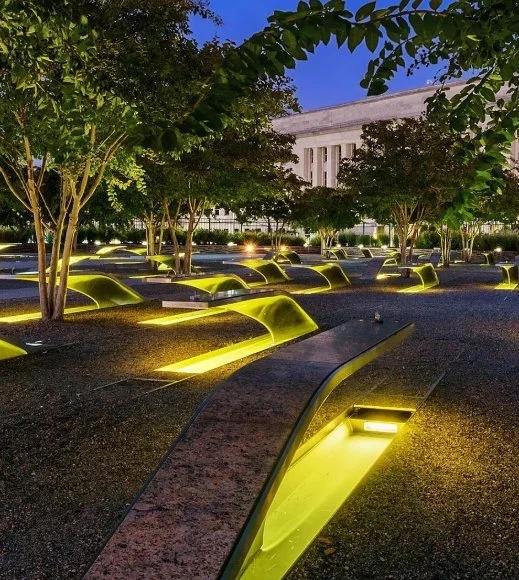
September 11, 2001, started like any other day. Sadly, it would not end that way. Of the 24,000 military and civilian employees who made their daily commute to the Pentagon in Washington, DC, 125 of them would pay the ultimate price, losing their lives when hijacked American Airlines Flight 77 crashed into the west side of the building.1
One of the victims inside the Pentagon was 27-year-old Angela M. Houtz.
Angela M. Houtz
Angela was born in La Plata, Maryland, on September 6, 1974. She graduated as salutatorian of Maurice J. McDonough High School and was awarded a full scholarship at the University of Maryland Baltimore County.2
After college, Angela worked in the Pentagon for the Chief of Naval Operations Intelligence Plot, where she also served as the naval intelligence watch officer in the Navy Command Center. She grew into the role of senior analyst.3
Like the others who were killed on 9/11, Angela didn’t know she would die that day. She didn’t know her family would be planning her funeral just days after her 27th birthday. She didn’t know she would be forever remembered with a memorial bench at the 9/11 Pentagon Memorial right outside the building where she died.
However, Angela did know how to live a worthy life.
As workers performed the grueling task of clearing out her desk, they found a list Angela left behind:
Things I Learned in CNO-IP:
1. Always give 100%.
2. Listen.
3. Care about each other as individuals. Be loyal.
4. Do not tolerate sloppy, lazy, or incomplete work.
5. Support your boss. Think ahead.
6. Remember your actions reflect on your office as a whole.
7. Always strive to be of service. Reject an “It’s not my lane in the road” attitude.
8. Work hard, play hard.
9. Laugh.
10. Be quick to praise.
11. Be honest.4
Angela’s list reflects her character. It is the way she lived her life. It is her legacy.
The Memorial’s Sacred Duty
Angela is just one of the 189 people who lost their lives when Islamic terrorists crashed a commercial airliner into the Pentagon: 125 were civilian and military employees in the Pentagon; 59 were passengers or crew aboard Flight 77; and five were cowards, bent on destroying America’s ideals.
The Pentagon 9/11 Memorial performs a sacred duty: It introduces sojourners to the people who died at the Pentagon on 9/11. Symbolically, the introduction is both personal and collective.
The memorial has 184 cantilevered benches spread over two acres.5 Each has a lighted pool of flowing water. One victim’s name is engraved at the end of each stainless-steel bench.
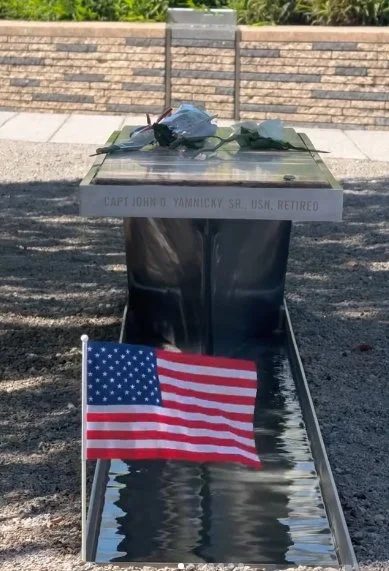
Visitors can discern whether the tribute is for a Pentagon worker or a passenger aboard Flight 77. For the 125 victims working inside the Pentagon, their names can be seen only when onlookers face the Pentagon. They see the name and the building in the same view as a single element. For the memorial units that honor the 59 who were on the plane, the visitor sees the victim’s name and the direction of the plane’s approach.6
One bench, one name, one view. This memorial is personal.
But it is also collective.
It helps us remember September 11, 2001, at exactly 9:37 a.m., when the actions of terrorists claimed a momentary victory: 184 victims killed in one catastrophic moment. Collectively, each memorial bench looks like all the others. Stainless steel is inlaid with smooth granite. Water flows quietly under each one. They died together.7
Our Cause—Worthy of Sacrifice
In honoring the lives lost at the Pentagon on 9/11, President George W. Bush made a promise:
““The wound to this building will not be forgotten, but it will be repaired.”
—President George W. Bush”
The wound to this building will not be forgotten, but it will be repaired. . . . Within sight of this building is Arlington [National] Cemetery, the final resting place of many thousands who died for our country over the generations. Enemies of America have now added to these graves, and they wish to add more. Unlike our enemies, we value every life, and we mourn every loss.
Yet we’re not afraid. Our cause is just, and worthy of sacrifice. Our nation is strong of heart, firm of purpose. Inspired by all the courage that has come before, we will meet our moment and we will prevail.8
At the Pentagon 9/11 Memorial, we are introduced to people like Angela who went to work on September 11, 2001, just as they did every other day. We are painfully aware, however, that 9/11 wasn’t like any other day. It was a day that changed us as a nation and revealed that “our nation is strong of heart, firm of purpose . . . and [that] we will prevail.”
As we sojourn to the Pentagon Memorial, may we take to heart what happened here, learning from the past so we can courageously lead the future, “always striv[ing] to be of service.”9 Just as Angela did.
Want to learn the past so you can help lead the future?
Sojourn with us to discover the places, people, and principles that have shaped Western civilization!
Email us at info@leadwithsojourn.com.
1 “Pentagon—Air Force,” Military Installations, accessed July 27, 2026, https://installations.militaryonesource.mil/in-depth-overview/pentagon-air-force.
2 “Angela M. Houtz,” The 9/11 Pentagon Memorial, accessed July 27, 2026, https://pentagonmemorial.org/biographies/angela-m-houtz/.
3 “Angela M. Houtz.”
4 “Angela M. Houtz.”
5 “Design Elements,” The 9/11 Pentagon Memorial, accessed July 27, 2026, https://pentagonmemorial.org/design-elements/.
6 “Design Elements.”
7 “Design Elements.”
8 George W. Bush, “9/11 Pentagon Remembrance Address,” American Rhetoric: Online Speech Bank, delivered October 11, 2001, https://www.americanrhetoric.com/speeches/gwbush911pentagonmemorial2001.htm.
9 “Angela M. Houtz.”