
Korean War Veterans Memorial
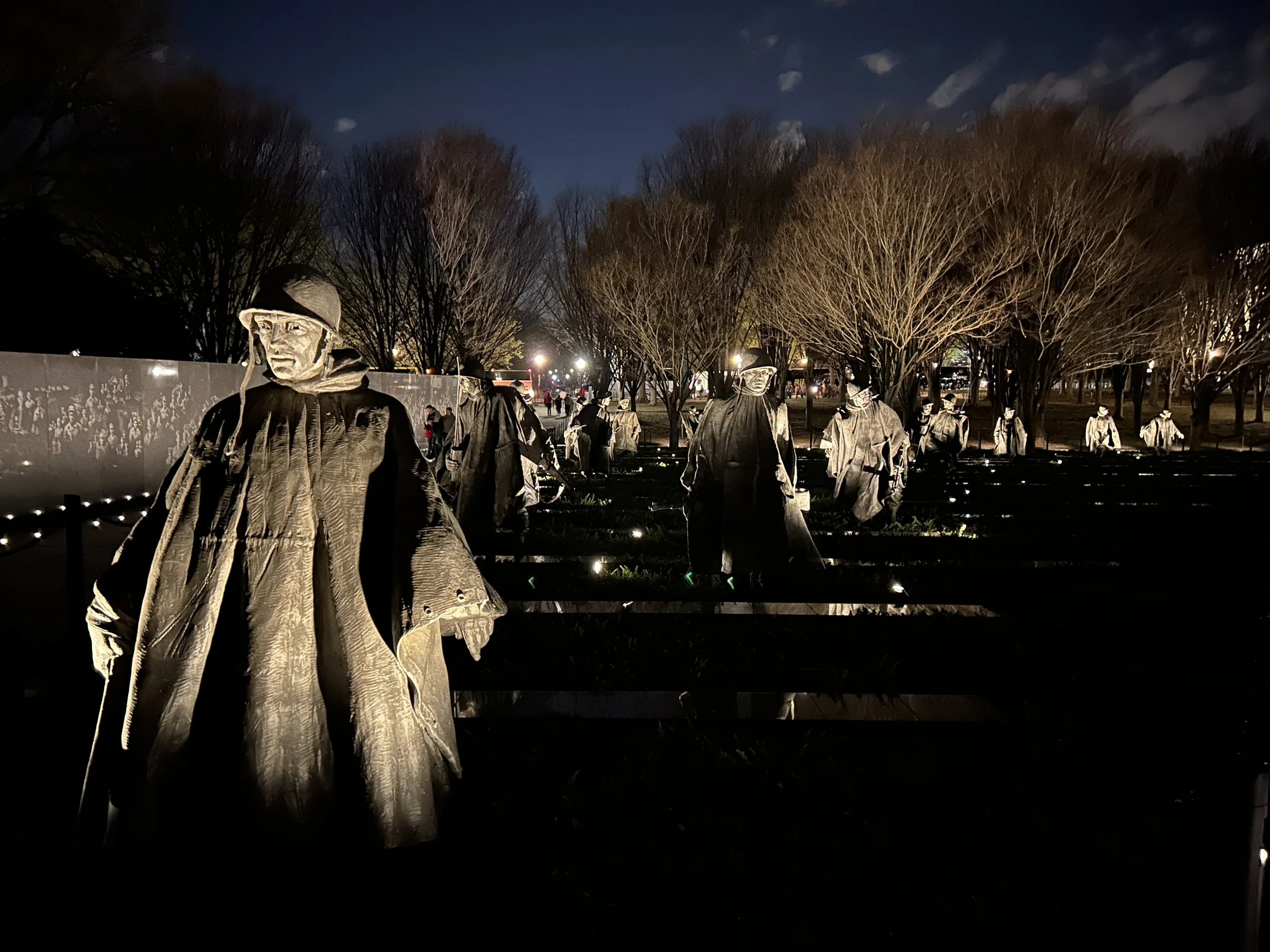
When you step onto the grounds of the Korean War Veterans Memorial in Washington, DC, you join a column of 19 American soldiers cast in stainless steel. These larger-than-life statues are on patrol, marching symbolically toward the 38th parallel. Soon you reach the marker that commemorates their sacrifice. It reads, “Our nation honors her sons and daughters who answered the call to defend a country they never knew and a people they never met.”1
You return your gaze to the soldiers. You see urgency in their eyes. You connect with the importance of their mission. You almost shiver empathetically when you notice the soldiers’ parkas blowing in the wind. The weather in the Korean jungle is an enemy all its own.
Marching with Them
The steel soldiers come from a variety of races and ranks and roles. They are scouts and warriors and medics. Some clutch radios. Others carry weapons. The medic shoulders the supplies that allow him to triage the wounded and the dying.
And the casualties will pile up. Over the 1,128 days of this long, three-year war, 36,574 American soldiers will die fighting for freedom,2 103,000 will be wounded, and more than 8,000 will forever be missing in action.3
It’s just the memorial we walk through, yet it all seems so real.
That’s because it was real — and because the sculptor knew a thing or two about the price of freedom. Frank Gaylord was a veteran himself, having served in World War II.
The chairman of the Korean War Veterans Memorial Foundation, retired Col. William Weber, a Korean War veteran, said that Gaylord “was able to convey in the artistry of the sculptures not only the authenticity of uniforms and equipment but also, with the flowing parkas and ponchos, the severity of the weather conditions under which that war was fought.”4
The Price of Freedom
“We travel to places of historical importance to get a perspective on the past — to learn from those who have come before us”
Although Frank Gaylord nailed the details of the soldiers — including their combat boots, helmets, and weapons — it’s their faces that catch your eye: their watchfulness, their urgency, their concentration. These details are what paint a portrait of the price of freedom. What you see on the soldiers’ faces feels genuine, not staged.
This is because the faces are genuine. Gaylord modeled the statues’ faces from old photographs of men who served their country in World War II and some who served in Korea.5 And Gaylord knew combat. Soon after his high school graduation, he “served in the 17th Airborne” in World War II “and fought in the Battle of the Bulge.”6 He “received the Bronze Star for Valor” and spent months nursing injuries he received while paying the price for freedom.7
No Longer a Tourist
Though the march of these soldiers is frozen in time for the 1.5 million veterans who fought for freedom in Korea, your march continues. You trudge on, drawn to the reflecting pool and the Wall of Remembrance. Your eyes perceive the message in large silver letters on the black granite: “Freedom Is Not Free.” Just four words convey this weighty truth.
But engraved in the granite that curves around the pool are the names of each and every one of the 36,574 servicemen who poured out their lifeblood to pay freedom’s price “for a country they never knew and a people they never met.”
The dense trees and scrubby juniper bushes invited you into the jungle of the Korean War Veterans Memorial. You and your comrades entered the conflict. You made your advance to the marker that commemorates sacrifice. Now you turn and walk away, equipped with an important lesson from the past: Freedom is never free.
And may that lesson forever echo in your heart as you lead the future for the cause of freedom.
Want to learn the past so you can help lead the future?
Sojourn with us to discover the places, people, and principles that have shaped Western civilization!
Email us at info@leadwithsojourn.com.
1 “Freedom Is Not Free,” Korean War Veterans Memorial, National Park Service, last updated September 25, 2024, https://www.nps.gov/kowa/index.htm.
2 “U.S. Military Casualties—Korean War—Casualty Summary,” Conflict Casualties, Defense Casualty Analysis System, accessed February 4, 2026, https://dcas.dmdc.osd.mil/dcas/app/conflictCasualties/korea/koreaSum.
3 “Wall and Pool of Remembrance,” Korean War Veterans Memorial, National Park Service, last updated July 26, 2022, https://www.nps.gov/kowa/learn/historyculture/wall-and-pool-of-remembrance.htm.
4 The Associated Press, “Frank Gaylord, Sculptor of Korean War Memorial Soldiers, Dies at 93,” Army Times, March 29, 2018, https://www.armytimes.com/news/your-army/2018/03/29/frank-gaylord-sculptor-of-korean-war-memorial-soldiers-dies-at-93/.
5 “On Patrol,” Korean War Veterans Memorial, National Park Service, last updated July 26, 2022, https://www.nps.gov/kowa/learn/historyculture/on-patrol.htm.
6 John Triano, “Biography,” Frank Gaylord Online Sculpture Studio, accessed February 4, 2026, https://trianoj.wixsite.com/frankgaylordonline/bio.
7 “Frank Gaylord, Sculptor, Papers,” Repository, West Virginia University, accessed February 4, 2026, https://archives.lib.wvu.edu/repositories/2/resources/6653.