
Gates of Harvard: Two Inscriptions
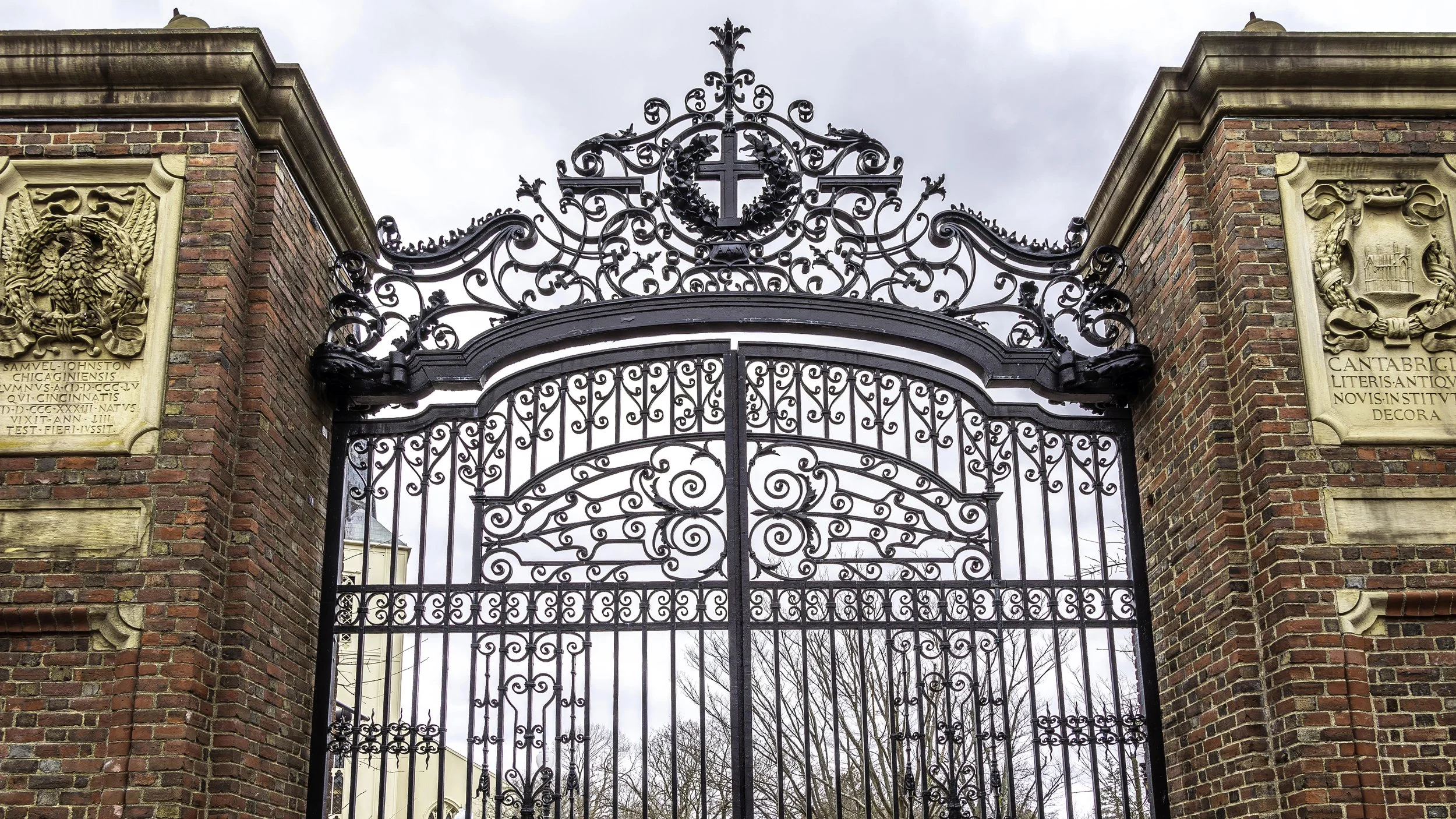
In the 1880s, Harvard University enclosed the heart of its campus with 25 gates between walls made of red brick and stone. Some say this was an act of elitism. But if one looks closely, they’ll see that the gates themselves tell quite a different story.
The Harvard gates serve as more than just points of entry around campus. These portals are “carefully wrought constructions that direct human movement and uplift everyday experience.”1 And most open inward rather than outward — signaling an invitation to enter.2
Ken Gewertz of TheHarvard Gazette observes, “To hurried, preoccupied pedestrians, [the gates’] details and decorations fade and blur, their inscriptions go unread. They are reduced to mere function, a passageway from the Yard to the street, from the street to the Yard. . . . But the Harvard Gates are more than that. Each has its own story to tell.”3
We must remember that stories of the past speak softly. And only those who choose to hear will learn what the gates have to teach.
The Dexter Gate
Consider the Dexter Gate on the south side of campus, on Massachusetts Avenue.
The gate is forged in iron and supported by century-old red brick and limestone. Engraved in the entablature are twin imperatives: “Enter to grow in wisdom” welcomes people as they come onto campus; “Depart to serve better thy country and thy kind” sends them on their way.4
Dozens enter and exit daily, hundreds weekly, thousands yearly.
And while people have passed through the Dexter Gate since 1901, how many have dedicated themselves to the maxim to “grow in wisdom”? How many “depart to serve”?
The Story of Samuel Dexter
Born from a tragic story, the Dexter Gate is a memorial gift that honors the wisdom of one of Harvard’s graduates: Samuel Dexter, esteemed member of the class of 1890. Samuel’s obituary overflows with promise:
Samuel Dexter, of Chicago, one of the most prominent members of the class of ’90, died yesterday morning at St. Margaret’s Hospital, Boston, of cerebrospinal meningitis, after a very brief illness. Mr. Dexter was a man of the highest endowments both physical and mental, and his sudden death removes one of the most promising of the recent graduates of Harvard. He was universally admired and respected, a man at once recognized as a natural leader by all with whom he came in contact.5
At the request of his mother, the gate’s design allotted space for the twin messages “Enter to grow . . .” and “Depart to serve . . .”6
Living a Legacy
Although Samuel Dexter never passed through the gate that bears his name, he seemed to embrace the twin inscriptions. He approached the opportunity to learn with fervor, and he departed as “one of the most promising of [Harvard’s] recent graduates.”
Yet his sudden departure begs for a third inscription — one from James, the brother of Jesus:
Come now, you who say, “Today or tomorrow we will go into such and such a town and spend a year there and trade and make a profit”—yet you do not know what tomorrow will bring. What is your life? For you are a mist that appears for a little time and then vanishes. (James 4:13–14 ESV)
Samuel Dexter’s life reflected the urgency of seizing the day.
The next time you make your sojourn to Boston, make your way to Harvard — entering and exiting through the Dexter Gate. And take time to let its lessons of the past permeate the way you live and lead.
Enter to learn. Depart to serve. Seize the day.
Want to learn the past so you can help lead the future?
Sojourn with us to discover the places, people, and principles that have shaped Western civilization!
Email us at info@leadwithsojourn.com.
1 Blair Kamin, ed., Gates of Harvard Yard (Princeton Architectural Press, 2016), 13.
2 Kamin, 15.
3 Ken Gewertz, “Enter to Grow in Wisdom,” Harvard Gazette, December 15, 2005, https://news.harvard.edu/gazette/story/2005/12/enter-to-grow-in-wisdom/.
4 Gewertz, “Enter to Grow in Wisdom.”
5 “Obituary: Samuel Dexter,” The Harvard Crimson, May 5, 1894,, https://www.thecrimson.com/article/1894/5/5/obituary-samuel-dexter-of-chicago-one/.
6 Kamin, 114.