
Turkey: Laodicean Ruins
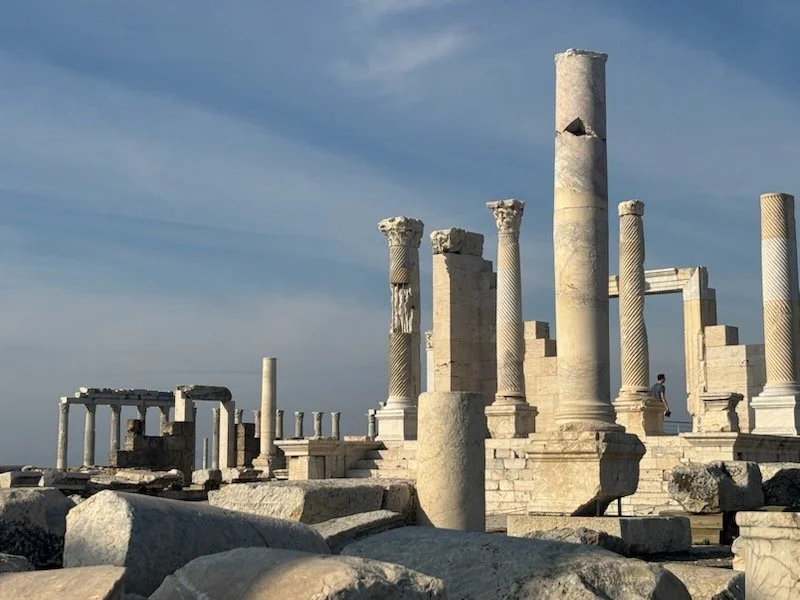
In the first century AD, Laodicea in modern-day Turkey was a money-making machine. Strategically placed on major trade routes, this ancient city had developed multiple revenue streams: It operated as a banking center; produced velvety-soft, raven-black wool for its textile industry; and boasted a standout medical school.
A Diversified Religious Portfolio
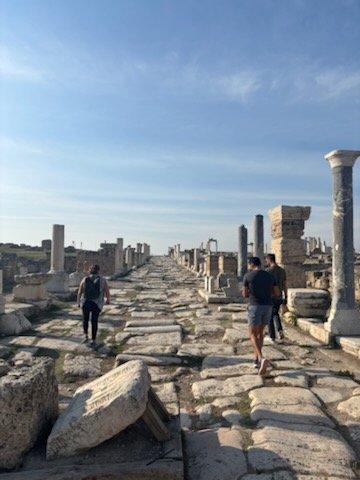
A sojourn to the ruins of Laodicea reveals financial good standing. It also points to a diverse religious portfolio. Hundreds of years before Christ, the Laodiceans’ preferred deity was Zeus.1 By the time Jesus was born, the temple tax on Hebrew males approached 9,000 half shekels (one half shekel for every Hebrew man). Clearly, Laodicea had a sizable and growing Jewish population. By the first century, the spread of Christianity had found fertile soil — enough to make the church at Laodicea one of the seven Asian churches mentioned in Revelation.
Seeing Clues in the Ruins
“a menorah, [a] lulav (palm branch), [a] shofar (ram’s horn), and [a] cross”
The scope of the Laodicean ruins is vast. To take it all in is, well, next to impossible. Visitors must focus their exploration. Those primarily interested in the classics might concentrate on the “remains from the Hellenistic and Roman periods,” which include “two theaters, a stadium, and a nymphaeum, a monumental fountain that continued in use into the Byzantine period.”2
Visitors drawn to the Judeo-Christian influence might focus on columns from the late Roman period. One particular “broken column fragment [has] four religious symbols: a menorah, [a] lulav (palm branch), [a] shofar (ram’s horn), and [a] cross.”3 This artifact alone gives testimony to the rich span of the ruins. “The column originally belonged to a nymphaeum (a public fountain) in Laodicea” from the Hellenistic period. “The Jewish symbols were likely added to the column in the late Roman or early Byzantine period. That the Christian cross extends from the Jewish menorah suggests that the Laodicean church grew out of the synagogue.”4
Laodicea’s Biblical Significance
What many Christian sojourners may remember about the church of Laodicea is the reprimand she receives from the Lord in Revelation chapter 3. Could God be anymore harsh than to call this congregation “lukewarm” and threaten to “spit [them] out of [his] mouth” (v. 16)?
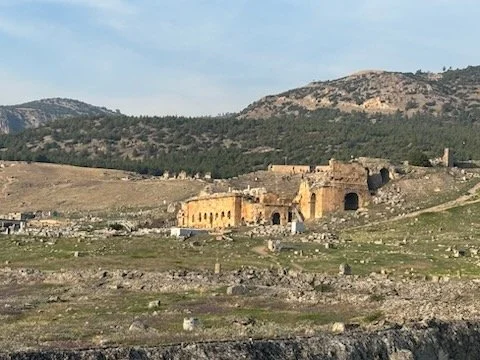
Being called lukewarm must have felt familiar to the Laodiceans. Just seven miles away, the city of Hierapolis “was famous for her hot springs.”5 Nearby Colossae boasted a cold-water supply. Laodicea relied on water brought into the city through Roman aqueducts. This made it suitable for drinking, but by the time it reached Laodicea, it was neither hot nor cold.
Additionally, God’s advice to strengthen the Laodiceans’ spiritual standing also would have had a familiar ring to it:
I counsel you to buy from me gold refined by fire, so that you may be rich, and white garments so that you may clothe yourself and the shame of your nakedness may not be seen, and salve to anoint your eyes, so that you may see. (Revelation 3:18)
Gold. White garments. Salve. Standing among the ruins, the significance of this triad is made clear.
God aimed his redemption plan at the Laodiceans’ three revenue streams: “Buy from me gold” — said to a city with a prosperous banking center. “Clothe yourself” in white garments — said to a city famous for black textiles. “Anoint your eyes” with salve — said to a city with a stellar medical school.
Standing on the ruins, you may absorb Revelation 3:18 differently than you would if reading it from the comfort of your home
God Knocks
God’s redemption offer continues with a familiar invitation:
Behold, I stand at the door and knock. If anyone hears my voice and opens the door, I will come in to him and eat with him, and he with me. (Revelation 3:20)
Is it possible that some of the Laodicean believers were cut to the heart? Is it possible they heard Jesus — and opened the door to him?
These questions are difficult, partly because no artifacts provide decisive answers. The ruins of the uncovered basilica reveal that the Laodicean church didn’t become divine spittle — not, at least, in the near term. But whether they became a vibrant, Christ-honoring church is harder to assess.
Tomorrow’s leaders come to the ruins of Laodicea willing to ask difficult questions in the presence of the artifacts that may or may not provide the answers. They come not only to explore the biblical significance of this historical site but to ponder God’s redemption plan, extended to us some 2,000 years later.
And they walk away learning that hearts, whether hard or lukewarm, can still be softened and refined in the fire by a strong and ever-persistent Redeemer.
Want to learn the past so you can help lead the future?
Sojourn with us to discover the places, people, and principles that have shaped Western civilization!
Email us at info@leadwithsojourn.com.
1 Clyde E. Fant and Mitchell G. Reddish, A Guide to Biblical Sites in Greece and Turkey (Oxford University Press, 2003), 233.
2 Noah Wiener, “Laodicea Columns Reveal the Grandeur of an Early Christian Center,” Bible History Daily (blog), Biblical Archaeology Society, August 14, 2013, https://www.biblicalarchaeology.org/daily/news/laodicea-columns-reveal-the-grandeur-of-an-early-christian-center/.
3 Megan Sauter, “The Church of Laodicea in the Bible and Archaeology,” Bible History Daily (blog), Biblical Archaeology Society, March 12, 2026, https://www.biblicalarchaeology.org/daily/biblical-sites-places/biblical-archaeology-sites/church-of-laodicea-in-the-bible-and-archaeology/.
4 Sauter, “The Church of Laodicea.”
5 Clyde E. Fant and Mitchell G. Reddish, A Guide to Biblical Sites in Greece and Turkey (Oxford University Press, 2003), 235.