
Galileo: Great Scientist and Accused Heretic
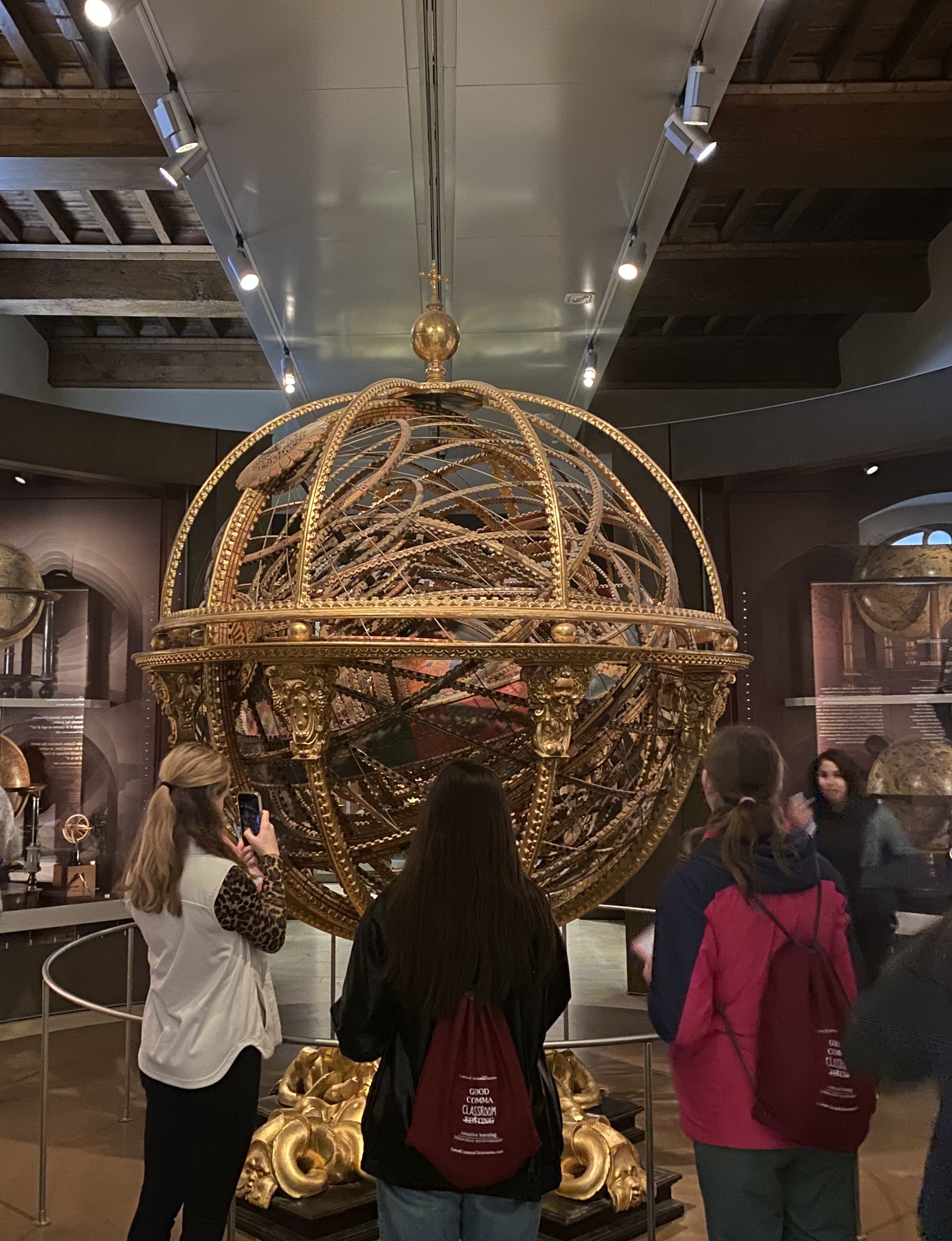
Along the Arno River in Florence, Italy, stands the Museo Galileo, honoring Galileo Galilei (1564–1642), the father of modern science. But being the patriarch of physics pales in comparison to his dogged opposition to the pope when facts collided with “faith.”
Galileo’s Discoveries
Galileo’s scientific discoveries put him light-years ahead of other scientists. It was Galileo, not Aristotle or Tesla, who discovered that objects in a vacuum will fall at the same rate of acceleration. It was Galileo, not Archimedes or Newton, who introduced inertia: the idea that an object, whether in motion or at rest, will remain so unless coming into contact with an external force. And yes, it was Galileo who challenged geocentricism — the belief that Earth was located at the center of the universe and the center of our solar system.1
Frustratingly, Galileo’s insistence on heliocentrism, in which the Sun is orbited by Earth and the other planets, “set him on a collision course with the Roman Catholic Church, culminating in his infamous trial and house arrest.”2
Galileo based his discovery on empirical evidence. This is significant to both the world of science and the world of faith.
Two Must-See Sites
Galileo’s contributions to science and his resulting collision with the Catholic Church make two sites in Florence must-see stops: the Museo Galileo — the museum that honors the patriarch of physics — and the Basilica of Santa Croce — his final resting place.
Inside the museum, your eyes will be opened to Galileo’s brilliance when you see his geometric and military compass. This “sophisticated and versatile calculating instrument” allowed him to perform “a wide variety of geometrical and arithmetical operations.”3 And make sure to view Galileo’s telescopes! These instruments allowed him to make “the sensational celestial observations that made him famous” to the world of science.4
Next, once you’ve taken the eight-minute stroll to the Basilica of Santa Croce, you’ll understand the “emblematic . . . tension between science and religious orthodoxy. Despite facing significant personal and professional challenges, Galileo’s advocacy for scientific inquiry has left an indelible mark on the history of science”5 and came with a high price.
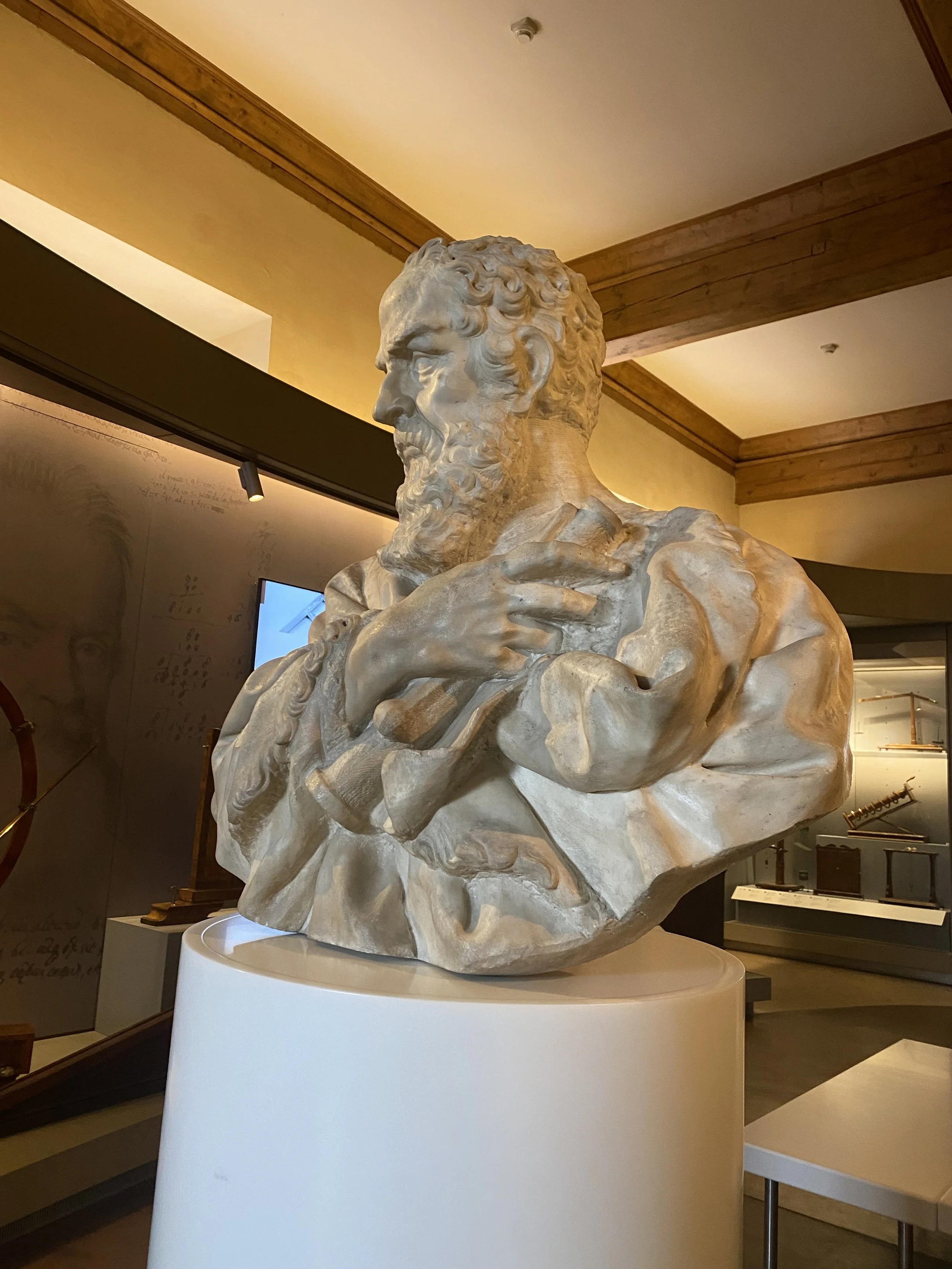
Inside the Basilica, you’ll find the Monumental Tomb of Galileo Galilei. The monument features his bust looking heavenward. Beneath the fold of his cloak, Galileo holds two of the instruments that most contributed to his renown: the geometric and military compass and one of his telescopes.
Here’s where the irony begins: Galileo’s fame extends beyond the truths these instruments revealed to him.
Finding True North
Symbolically, Galileo’s compass was set on true north. This allowed him to challenge the conventional wisdom of his era, but not out of youthful rebellion or intellectual cynicism. He boldly pursued truth when he challenged geocentricism. His telescope proved that the Sun was at the center and that the planets revolved around it by God’s design.
The father of modern science set his compass on revealed truth. But sadly, as a result of his trial for his belief in heliocentrism, Galileo eventually caved to the will of the Roman Catholic Church. As an old man in failing health, he softened his position in a kind of plea agreement: “He . . . confessed that he had given stronger arguments to the heliocentric proponent in his dialogue than to the geocentric champion.”6 After this, Rome softened its punishment from execution to house arrest. Opposing the church had exacted a price.
When Galileo died in 1642, he was laid to rest in a “family tomb in Santa Croce . . . buried, almost secretly.”7 It would be 95 years before this man, whom the church accused of heresy, would be honored with “a funerary monument celebrating [him as] the great scientist.”8
Artifacts in museums tell the partial story of Galileo’s legacy. But behind those artifacts is the full story, urging us to stake our reputation on truth — even when it goes against the ever-changing winds of contemporary culture.
We also learn a lesson from Galileo’s partial recantation. Holding to the truth in the face of stern opposition can make even the strongest among us falter. Just ask Peter. Or Thomas. Or David. Or Jacob. (Sadly, the list goes on — arguably including each person who has ever lived).
Before he stumbled, Galileo demonstrated courage in his convictions. And long after, God continues to use his story to show us how truth will ultimately prevail.
Though it took hundreds of years, eventually the Roman Catholic Church discovered that the man they accused of heresy was correct in his claims that the Earth revolves around the Sun — just as God designed it to.
Want to learn the past so you can help lead the future?
Sojourn with us to discover the places, people, and principles that have shaped Western civilization!
Email us at info@leadwithsojourn.com.
1 “9 Major Achievements of Galileo Galilei,” World History Edu, October 20, 2023, https://worldhistoryedu.com/major-achievements-of-galileo-galilei/.
2 World History Edu, “9 Major Achievements of Galileo Galilei.”
3 “Instruments,” Geometric and Military Compass, Museo Galileo, accessed January 23, 2026, https://www.museogalileo.it/en/galileo/instruments-en.html.
4 “Instruments,” Galileo’s Telescope, Museo Galileo, accessed January 23, 2026, https://www.museogalileo.it/en/galileo/instruments-en.html.
5 World History Edu, “9 Major Achievements of Galileo Galilei.”
6 Jessica Wolf, “The Truth About Galileo and His Conflict with the Catholic Church,” UCLA Newsroom, December 22, 2016, https://newsroom.ucla.edu/releases/the-truth-about-galileo-and-his-conflict-with-the-catholic-church.
7 “Giovanni Battista Foggini (Design),” Santa Croce Opera, accessed January 26, 2026, https://www.santacroceopera.it/en/catalogue-of-works/galileo-galilei-monumental-tomb-foggini/.
8 Santa Croce Opera, “Giovanni Battista Foggini.”