
Michelangelo’s Madonna della Pietà
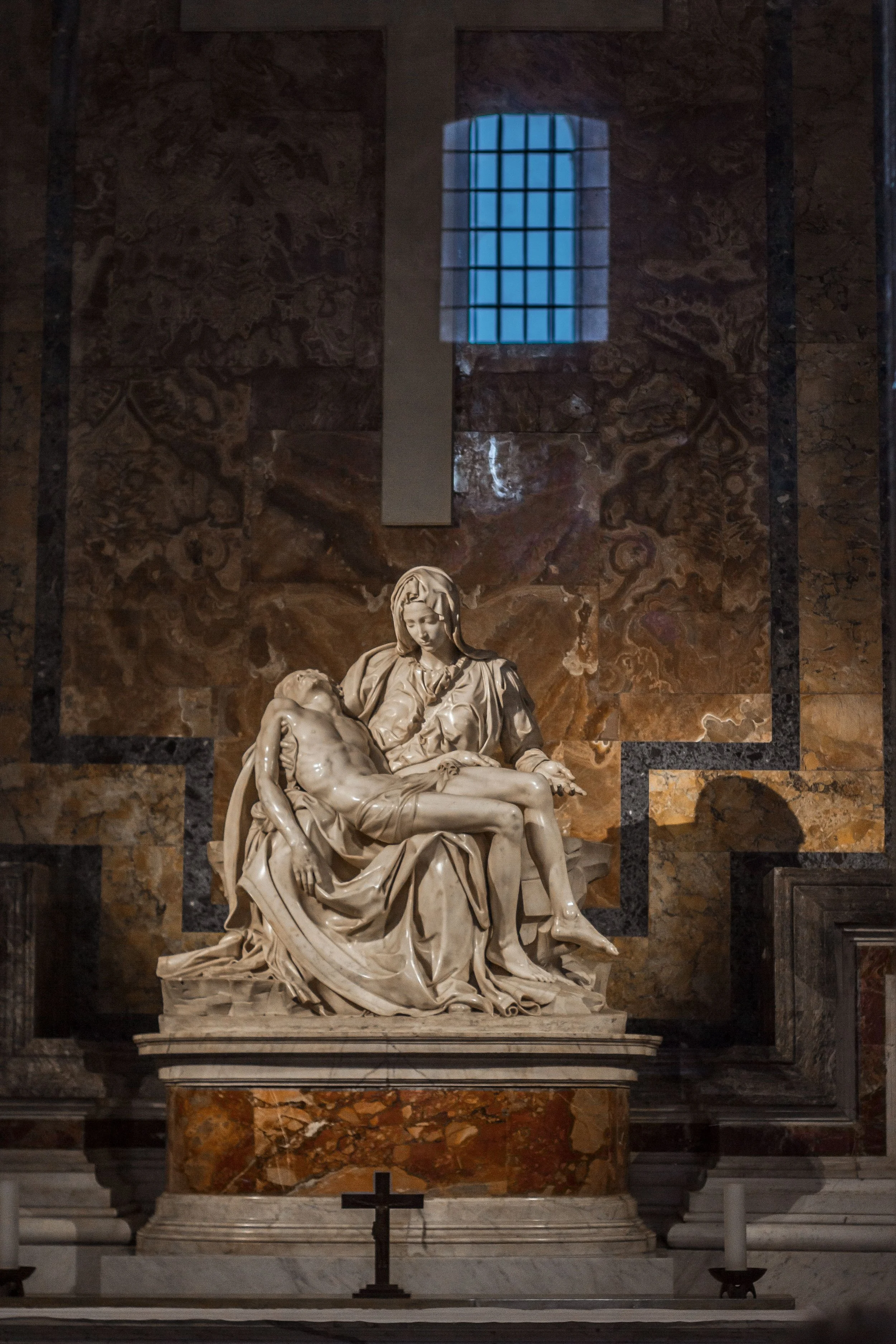
When you sojourn to St. Peter’s Basilica in Vatican City, you will cast your eyes on a Michelangelo masterpiece. The Madonna della Pietà took 23-year-old Michelangelo just nine months to sculpt from one piece of Carrara marble. This five-foot by six-foot sculpture portrays Mary, the mother of Jesus, holding her Son’s body just after He was taken off the cross. Michelangelo’s masterpiece portrays the sixth in the “Seven Sorrows of Mary.”
As you examine Michelangelo’s artistic interpretation of Jesus in the arms of his mother, you are seeing a snapshot of a painful moment in time.
Intentional Artistic License
Gaze at the stillness. You’ll notice Jesus’s corpse:
[His] body, apparently motionless, pitifully lying on the shroud stretched over his mother’s lap, is already divine: The marks of the scourging, the crown of thorns, the martyrdom and the falls on the way to Calvary have vanished. The nail holes on his hands and feet, as well as the wound on his side, have only symbolic value.
The dead body of Jesus shows diminished signs of the torture that culminated in His execution. This is not a mistake by the young sculptor; it is his intent. He portrays Jesus as “already divine,” healing from the brutality handed to him by the Romans.
“it is natural to sympathize with the emotions the sculptor assigned to Mary: “The sorrow of holding His lifeless body would have overwhelmed any parent, reminding us of the weight of humanity’s sin and the depth of Mary’s lament.””
Mary’s image will also strike you. Her face is young, much too young to be the mother of the 33-year-old Son she is holding. Michelangelo did not err in portraying Jesus’s mother this way. Her face resembles the youthful virgin who replied to Gabriel “Behold, I am the servant of the Lord; let it be to me according to your word” (Luke 1:38) when the angel announced God’s plan for her virgin conception. Yes, Michelangelo sculpted Mary as “a Mother who appears younger than her Son, . . . [who] is at the same time Mother, Daughter, and Bride,” as Nanni di Baccio Bigio wrote in 1549.
As you gaze at Michelangelo’s masterpiece, it is natural to sympathize with the emotions the sculptor assigned to Mary: “The sorrow of holding His lifeless body would have overwhelmed any parent, reminding us of the weight of humanity’s sin and the depth of Mary’s lament.”
Mary’s Seven Sorrows
But youth and sorrow are joined by a gentle resolve in the face of Mary. It makes sense: According to tradition, this is the sixth identified sorrow this mother had endured. From the time Jesus was conceived and born, God had hardened her resolve and deepened her devotion to her Son, the Savior.
The first of the seven sorrows traces back to when Jesus was just days old and Simeon gave this prophecy to Mary: “Behold, this child is appointed for the fall and rising of many . . . (and a sword will pierce through your own soul also)” (Luke 2:34–35). The second and third sorrows occur before Jesus was a teenager: the family’s flight to Egypt when Jesus was newly born and the three days of agony when the 12-year-old Jesus was separated from His parents at the temple. The balance of Mary’s seven sorrows center around Golgotha, from the march on the Via Dolorosa (the sorrowful road), to the Crucifixion, and finally, to the grave.
The Madonna della Pietà shows the sixth sorrow, the moment Mary holds her dead Son before He is taken by Joseph of Arimathea and Nicodemus for burial.
Michelangelo’s marble creation reveals Mary with quiet strength and unwavering trust in God’s providence. She had shown a similar strength when Gabriel first announced God’s plan.
True, Good, and Beautiful
They say that one way to evaluate art is to apply the standard of the true, the good, and the beautiful.
Is it true? We can ask, “Does this piece effectively imitate reality in some way?”
Undeniably. Michelangelo revealed things no photograph could. He showed that Jesus’s divinity has resurrection healing from the wounds inflicted by human hands.
He also showed Mary as the young woman who grew into what Gabriel had proclaimed: “Greetings, O favored one, the Lord is with you!” (Luke 1:28). And He was: He had been with her through all her sorrows — from Jesus’s conception to His death.
Is it good? We can ask, “Does this piece inspire virtue?”
Without a doubt. Michelangelo stops you in your tracks as you gaze at Pietà. You want to hold the Savior in your arms like Mary. You want to imitate her strength and unwavering trust in God.
Is it beautiful? We can ask, “Does this piece show technical excellence, combining good form with good meaning?”
Giorgio Vasari, a contemporary of Michelangelo (and an artist in his own right), said it best when he first set eyes on the Pietà: “Certainly it is a miracle,” he wrote, “that a stone, ‘from the beginning’ without any form, has ever been reduced to that perfection, which nature with difficulty is able to shape in the flesh.”
Another Important Question
When you first set eyes on the Pietà, you will have the opportunity to evaluate this important moment of the past. As you gaze at Michelangelo’s masterpiece, ask yourself this: What does it invite me to think about? To feel? To believe?
As you answer these questions, you will better understand: When we learn the past, we are able to lead the future.
Want to learn the past so you can help lead the future?
Sojourn with us to discover the places, people, and principles that have shaped Western civilization!
Email us at info@leadwithsojourn.com.
1 Pietro Zander, “The Pietà of Saint Peter’s,” Basilica di San Pietro, accessed April 7, 2026, https://www.basilicasanpietro.va/en/san-pietro/the-pieta-of-saint-peter-s.
2 Wikipedia, “Pietà (Michelangelo),” last edited June 13, 2026, 06:57 (UTC), https://en.wikipedia.org/wiki/Piet%C3%A0_(Michelangelo).
3 “What Are Mary’s Seven Sorrows?,” Bible Hub, accessed April 6, 2026, https://biblehub.com/q/what_are_mary%27s_seven_sorrows.htm.
4 Zander, “The Pietà of Saint Peter’s.”
5 Zander, “The Pietà of Saint Peter’s.”
6 Zander, “The Pietà of Saint Peter’s.”
7 “What Are Mary’s Seven Sorrows?”
8 Merriam-Webster Dictionary, “via dolorosa,” accessed April 9, 2026, https://www.merriam-webster.com/dictionary/via%20dolorosa.
9 Zander, “The Pietà of Saint Peter’s.”